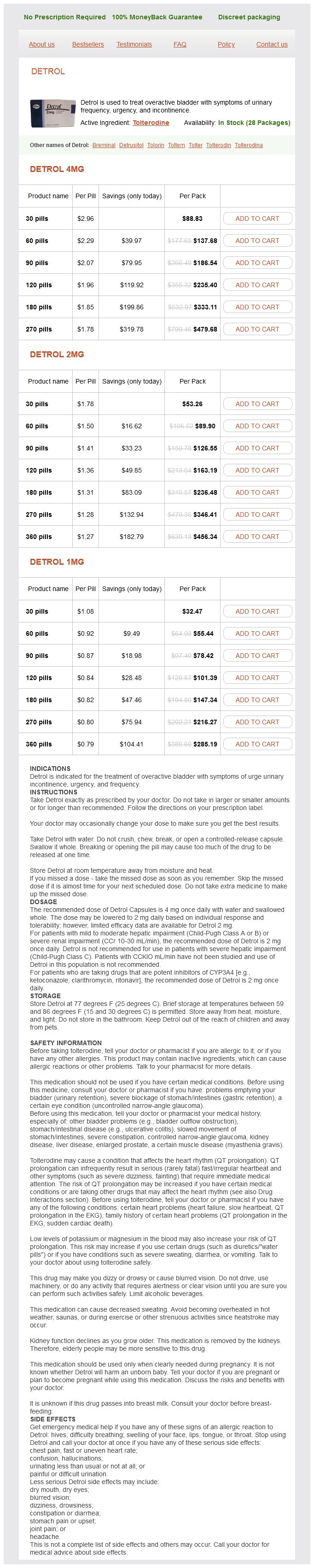

Tolterodine dosages: 4 mg, 2 mg, 1 mg
Tolterodine packs: 30 pills, 60 pills, 90 pills, 120 pills, 180 pills, 270 pills, 360 pills

Tolterodine 4 mg on-line
Poorly differentiated adenocarcinomas should show a minimum of some gland formation or mucus production; tubules are sometimes irregularly folded and distorted. When a carcinoma has heterogeneity in differentiation, grading should be based mostly on the least differentiated element, not together with the leading front of invasion. Small foci of obvious poor differentiation are frequent on the advancing edge of tumours, however this function is insufficient to classify the tumour as poorly differentiated 1543. The proportion of the tumour exhibiting formation of gland-like structures can be used to outline the grade. Well differentiated (grade 1) lesions exhibit glandular constructions in > 95% of the tumour; reasonably differentiated (grade 2) adenocarci- Carcinosarcoma Carcinomas that embody a spindle cell part are best termed sarcomatoid carcinoma or spindle cell carcinoma. B Mucinous adenocarcinoma beneath high-grade intraepithelial neoplasia in ulcerative colitis. Mucinous adenocarcinoma and signet-ring cell carcinoma by convention are thought of poorly differentiated (grade 3). Precursor lesions During the previous decade the pure historical past of colorectal carcinomas has been extensively studied in correlation with the underlying accumulation of genetic alterations. Microscopic examination of Adenomas these precursor lesions are outlined by the presence of intraepithelial neoplasia, histologically characterized by hypercellularity with enlarged, hyperchromatic nuclei, various degrees of nuclear stratification, and lack of polarity. Intraepithelial neoplasia may be low-grade or highgrade, relying on the diploma of glandular or villous complexity, extent of nuclear stratification, and severity of irregular nuclear morphology. Paneth cells, neuroendocrine cells and squamous cell aggregates could additionally be seen in adenomas and will become a dominant constituent of the epithelium. Colorectal adenomas could be categorized into three groups: elevated, flat, and depressed 973. Elevated adenomas range from pedunculated polyps with an extended stalk of non-neoplastic mucosa to those that are sessile. Flat or non-protruding adenomas and depressed adenomas are acknowledged macroscopically by mucosal reddening, refined modifications in texture, or highlighting by dye techniques. Depressed adenomas are normally smaller than flat or protruding ones and have a tendency to give rise to adenocarcinoma whereas nonetheless comparatively small (mean diameter, eleven mm) as a outcome of a larger tendency to progress 1628. Tubular adenomas are normally protruding, spherical and pedunculated, or non-protruding (flat). Microscopically, dysplastic glandular structures occupy a minimal of 80% of the luminal floor. Microscopically, leaf-like projections lined by dysplastic glandular epithelium comprise greater than 80% of the luminal floor. Distinction of villous constructions from elongated separated tubules is usually problematical. Villous structure is outlined arbitrarily by the size of the glands exceeding twice the thickness of normal colorectal mucosa. Tubulovillous adenomas have a combination of tubular and villous constructions with a ratio between 80%/20% and 20%/80%. Serrated adenomas are characterized by the saw-tooth configuration of a hyperplastic (metaplastic) polyp on low power microscopy, but the epithelium lining the higher portion of the crypts and luminal surface is dysplastic. By contrast, combined hyperplastic polyp/adenoma accommodates separate identifiable areas of each histopathological type 1092. Occasionally, some villous adenomas show within the slopes of the villi closely packed small glands; these adenomas have been referred to as villo-microglandular adenomas 972. The extended time interval often required for progression of intraepithelial to invasive neoplasia provides opportunities for prevention or interruption of the process to scale back mortality because of colorectal carcinoma. Intraepithelial neoplasia also can happen within the absence of an adenoma, in a preexisting lesion of another type (such as a hamartomatous polyp in juvenile polyposis syndrome and Peutz-Jeghers syndrome), and in chronic inflammatory illnesses. Hyperplastic (metaplastic) polyps the definition is a mucosal excrescence characterized by elongated, serrated crypts lined by proliferative epithelium within the bases with infolded epithelial tufts and enlarged goblet cells within the higher crypts and on the luminal floor, imparting a saw-tooth outline. In the appendix, diffuse hyperplasia may happen as a sessile mucosal proliferation. The epithelial nuclei in the serrated region are small, common, spherical and located at. The cytoplasm accommodates outstanding mucin vacuoles, which are usually larger than regular goblet cells. The proliferative zone usually shows elevated cellularity and mitotic activity, which may be mistaken for adenoma. Hyperplastic polyps are traditionally thought-about non-neoplastic, but ras mutation is frequent, clonality has been demonstrated, and biochemical abnormalities and epidemiological associations that happen in colorectal adenomas and carcinomas have been found 851, 663, 1178.
Order tolterodine 4 mg without a prescription
Midodrine and funky dialysis resolution are effective therapies for symptomatic intradialytic hypotension. Association of mortality threat with various definitions of intradialytic hypotension. Increase in post-dialysis hemoglobin can be out of proportion and unrelated to ultrafiltration. Gabapentin therapy for pruritus in hemodialysis patients: a randomized placebo-controlled, double-blind trial. Life-threatening complications of extracorporeal treatment in sufferers with severe eosinophilia. Oxygen, arterial blood gases and air flow are unchanged throughout dialysis in patients receiving pressure support air flow. Effect of oxygen therapy on hemodynamic stability throughout hemodialysis with steady blood quantity and O2 saturation monitoring [abstract]. Severe coronary stenosis is an important issue for induction and lengthy persistence of ventricular arrhythmias during and after hemodialysis. A randomized, managed trial of albumin versus saline for the treatment of intradialytic hypotension. Narowband ultraviolet B phototherapy for sufferers with refractory uraemic pruritus: a randomized managed trial. Aldosterone deficiency as the purpose for intradialytic hypotension and its profitable management with fludricortisone [abstract]. Use of small doses of furosemide in persistent kidney disease sufferers with residual renal operate present process hemodialysis. Hypersensitivity reactions during haemodialysis: role of complement fragments and ethylene oxide antibodies. Effects of different membranes and dialysis technologies on patient therapy tolerance and dietary parameters. Increased dietary sodium is independently related to larger mortality among prevalent hemodialysis patients. Interaction of potassium, sodium with greater magnesium dialysate on muscle cramps in chronic hemodialysis patients [abstract]. Etiology and prognostic significance of severe uremic pruritus in persistent hemodialysis sufferers. Rationale and design of a multi-centre randomised controlled trial of individualised cooled dialysate to forestall left ventricular systolic dysfunction in haemodialysis patients. Effect of the membrane biocompatibility on dietary parameters in continual hemodialysis sufferers. Cardiac evaluation in hypotension-prone and hypotensionresistant dialysis patients. Pseudopulmonary embolism: acute respiratory distress within the syndrome of heparin-induced thrombocytopenia. Intradialytic blood quantity monitoring in ambulatory hemodialysis sufferers: a randomized trial. Cardiac modifications in uraemia and their attainable relationship to cardiovascular instability on dialysis. Does a reduction in dialysate sodium improve blood pressure control in haemodialysis sufferers Effect of variations in dialysis answer temperature on blood strain throughout hemodialysis. The effect of dialysis answer calcium ranges on blood strain throughout hemodialysis. Vasopressin secretion by hypertonic saline infusion throughout hemodialysis: impact of cardiopulmonary recirculation. Symmetric and uneven left ventricular hypertrophy in sufferers with end-stage renal failure on long-term hemodialysis. Effect of dialysis solution calcium concentration on intradialytic blood stress course in cardiac-compromised patients. DeOreo A dialysis facility might use dialyzers for the same affected person for multiple remedies. As the value of high-flux, biocompatible dialyzers has come down, prevalence of reuse in the United States has fallen from 78% of facilities within the mid-1990s to about 50% of amenities (47% of patients) in 2013 (Upadhyay, 2007; Neumann, 2013). Only hollow-fiber dialyzers, labeled by the manufacturer for a number of use, could additionally be reprocessed. Automated tools also facilitates printing of dialyzer labels and computerized analysis of information and testing outcomes.
Order genuine tolterodine on-line
However, they may also be present as band-like or patchy microscopic lesions totally confined to the mucosa 303. In contrast, the monomorphic small to medium-sized variant characteristically lacks fibrotic changes and inflammatory background 307. A B Histopathology of the enteropathic mucosa In the vast majority of circumstances, the macroscopically normal intestinal mucosa reveals options of coeliac illness, i. Furthermore, enteropathy may be minimal or absent if the affected person is on a gluten free food plan, or if enteropathic sites are missed because of their patchy distribution. The non-neoplastic mucosa distant from an anaplastic massive cell intestinal T-cell lymphoma shows villous atrophy, crypt hyperplasia (A) and a rise in cytologically unremarkable intraepithelial lymphocytes (B) with out evidence of lymphoma. In a minority nonetheless, endoscopic biopsies, usually taken from the abdomen, duodenum, or colon, are available. These patients incessantly have an extended than 6 months history of belly ache and weight reduction. Furthermore, the neoplastic infiltrate could additionally be delicate or superficial and subsequently easily overlooked in routinely stained sections. Prognosis and predictive elements the clinical course could be very unfavorable as a result of complications from peritonitis and malnutrition and later from progressive illness sometimes characterized by intestinal recurrences. The malabsorption because of underlying coeliac illness is detrimental to these patients, notably when recovering from surgery or receiving multiagent chemotherapy 444. The total median survival in the largest revealed collection is only 3 months, and 5-year survival on this and other sequence ranges from 8-25% 305, 424, 444. The small group of long-term survivors normally obtained chemotherapy and, apparently, none had a previous analysis of coeliac disease 305, 444. Epidemiology Sarcomas account for approximately 14% of malignant small intestinal tumours 1928. Age of onset for sarcomas was decrease than for carcinomas, with black females showing the lowest median age, 50 years. Localization Sarcomas present a method more even distribution throughout the small bowel compared to adenocarcinomas and carcinoids 1928. Mesenchymal neoplasms of small bowel are more difficult to diagnose by endoscopy or imaging research than these in the abdomen. Macroscopy Small bowel sarcomas usually appear macroscopically as those within the stomach. Some small intestinal tumours may trigger aneurysmal bowel dilatation, while others have a diverticulum-like appearance. Even with low or absent mitotic activity, tumours bigger than 5 cm are thought of to have malignant potential. Angiosarcomas are recognized by an anastomosing proliferation of atypical endothelial cells. Kaposi sarcomas could involve small intestine, both the mucosa alone or extra extensively. Prognosis the prognosis of small bowel sarcomas is basically depending on the mitotic count, size, depth of invasion, and presence or absence of metastasis. In a study of over one thousand stromal/smooth muscle sarcomas, the 5-year survival fee was 55% for sarcomas of small bowel, 60% for colorectum, 70% for stomach and 75% for oesophagus 462. Sobin Definition Tumours of the intestines that originate from an extra-intestinal neoplasm or which are discontinuous with a main tumour elsewhere in the gastrointestinal tract. Epidemiology Metastatic unfold to the small intestine is more frequent than to another website within the gastrointestinal tract (see Table three. Secondary carcinomas of the small bowel are as frequent as major carcinomas at this website 1234. Origin For small intestine, melanoma, lung, breast, colon and kidney are essentially the most frequent major sites (see Table 3. Metastatic spread from primary lung most cancers to the small intestine is more frequent than to abdomen and colon (Table four. Virtually all primary cancers can occasionally lead to metastases in the small intestine and, due to the low frequency of main small bowel most cancers, a high proportion of small intestinal malignancies are metastatic. The pathogenesis of intestinal metastasis normally entails haematogenous spread of tumour cells.
Buy tolterodine 2 mg on line
The layers of compounds in the cartridge reap the advantages of three primary rules of chemistry: carbon binding, enzyme conversion, and ion exchange, to remove uremic toxins and regenerate high-quality bicarbonate dialysate throughout a dialysis therapy. Sorbent devices operate with out being connected to a water provide or a drain; subsequently, extra advantages are system mobility and the flexibleness of therapy supply in a extensive range of environments. Sorbent systems have been used for acute dialysis in critical care items and at the patient bedside, for house hemodialysis, for navy operations, for disaster aid, in rehabilitation centers and nursing homes, in distant places, and to treat sufferers on vacation in remote places. Without the necessity for plumbing installation or electrical modification, the potential therapy environments with sorbent systems are quite a few. Sorbent techniques present a chance to drive innovation, portability, flexibility, and miniaturization in the dialysis area. In sorbent dialysis, the spent dialysate is constantly regenerated to kind fresh dialysis answer by passing it via a sorbent cartridge. The preliminary dialysis solution is mixed in a delegated jug utilizing dry powders and 6 L or much less of potable tap water. Prior to starting dialysis, this initial solution is recirculated via the sorbent cartridge for the purpose of removing contaminants. Once dialysis has been initiated and the affected person has been linked into the system, the "spent" dialysate is then routed from the dialyzer outlet port via the sorbent cartridge. In the cartridge, metabolic waste merchandise dissolved within the spent dialysate are adsorbed and/or exchanged for 360 Chapter 19 / the Relevance of Sorbent Technology Today 361 sodium, hydrogen, and bicarbonate ions. Regeneration of the final dialysate solution is completed when potassium, calcium, and magnesium are added to the dialysis answer exiting the cartridge by an infusion pump. The first and third layers with which the dialysate comes into contact contain activated carbon. These layers adsorb heavy metals, chloramines, and different contaminants that may be discovered in the faucet water. In addition, the activated carbon adsorbs lots of the organic and center molecule uremic solutes found in spent dialysate, including creatinine and uric acid. The enzyme current is urease, which catalyzes the conversion of urea to ammonium bicarbonate. Its primary function is to adsorb the ammonium ion generated by urea hydrolysis that took place in the second layer. In addition, this cation exchange material adsorbs other positively charged species corresponding to magnesium, calcium, and potassium, in addition to heavy steel cations that could be found in tap water such as copper and iron. In trade for the adsorbed cations, the zirconium phosphate releases hydrogen and sodium. This material adsorbs phosphate, fluoride, and other anions, such as oxoanions of heavy metals, and in trade release chloride and hydroxyl anions. Removal of contaminants from the prime solution throughout predialysis recirculation by way of the sorbent cartridge. The preliminary dialysis solu- tion or "prime" is made by combining dry chemical compounds with 6 L or less of municipal tap water. Changes to the electrolyte composition of the prime resolution throughout predialysis recirculation. Concentrations of sodium bicarbon- solely 6 L of faucet water are used, the whole sulfate (or nitrate) load probably transferable to the patient is small. Upon priming the cartridge, a portion of the sodium within the prime shall be adsorbed by the zirconium phosphate layer of the cartridge in trade for hydrogen ions. The launch of those hydrogen ions into the priming dialysis answer would result in a lowering of the starting bicarbonate focus initially current in the prime answer because the protons react with bicarbonate to kind carbonic acid. However, launch of sodium bicarbonate from the sixth layer of the cartridge serves as a buffer and prevents the bicarbonate focus of the prime solution from dropping in the course of the predialysis recirculation interval. In reality, the preliminary bicarbonate concentration of the prime on the end of the predialysis recirculation section typically might be slightly greater than the preliminary bicarbonate stage of the prime on the time of mixing. Instead, once therapy begins, these elements are infused at appropriate charges into the stream exiting the cartridge; in consequence, the ultimate dialysis resolution that reenters the dialyzer accommodates appropriate concentrations of those ions. Sodium within the dialysis answer originates from three sources: the sodium-containing electrolytes added to the prime resolution, sodium added to the dialysate by the cartridge from cation change and from the sodium bicarbonate layer, and diffusion of sodium from affected person blood to dialysate in the dialyzer. The zirconium phosphate layer adsorbs the ammonium that was generated from enzymatic conversion of urea, and it additionally adsorbs magnesium, calcium, and potassium. In exchange for these adsorbed cations, the zirconium phosphate layer releases sodium and hydrogen.
Generic tolterodine 4mg amex
Dialysis solution magnesium ranges could impression dialysis hypotension, however whether the next or a decrease degree should be used is controversial (Chapter 10). Rarely, hypotension during dialysis could additionally be a sign of an underlying, critical event. Most patients complain of feeling dizzy, light-headed, or nauseated when hypotension occurs. Others could experience very refined symptoms, which may be recognizable solely to dialysis staff conversant in the patient. For this purpose, blood pressure must be monitored frequently throughout the hemodialysis session. Whether this is accomplished hourly, half-hourly, or on a extra frequent foundation is decided by the individual case. The affected person ought to be placed in the Trendelenburg place (if respiratory standing allows this) and a bolus of 0. Ultrafiltration may be resumed (at a slower price, initially) once important indicators have stabilized. As a substitute for saline, glucose, mannitol, or albumin solutions can be utilized to deal with the hypotensive episode; albumin is costly and provides little benefit over different approaches (Knoll, 2004); mannitol accumulates, decreasing its benefit on subsequent remedies. The practice was believed to be beneficial as a outcome of lower blood flow charges lowered (a) intradialyzer blood quantity, (b) acetate (a vasodilator) transfer to the affected person, (c) ultrafiltration fee, and (d) fistula "steal. However, if hypotension is severe or unresponsive to stopping ultrafiltration and infusion of volume expanders, blood pump charges could also be transiently lowered. Repeated slowing of the blood circulate fee will scale back solute elimination and trigger underdialysis. The four most necessary predisposing components are hypotension, hypovolemia (patient below dry weight), high ultrafiltration fee (large weight gain), and use of low-sodium Chapter 12 / Complications during Hemodialysis 223 1. If predialysis serum sodium is low, consider the extent of dialysis answer sodium versus serum sodium. If substantial residual kidney operate exists, contemplate growing urine quantity using diuretics. Give day by day dose of antihypertensive drugs after, not earlier than, dialysis; change remedy to shorter-acting agents. Assess the advantages of a predialysis hemoglobin level persistently = 10�11 g/dL (100�110 g/L). Do not give food or glucose orally during, or immediately preceding, dialysis to hypotension-prone sufferers. These factors all tend to favor vasoconstriction, resulting in muscle hypoperfusion, resulting in secondary impairment of muscle relaxation. Muscle cramps most commonly occur in affiliation with hypotension, although cramps often persist after seemingly enough blood pressure has been restored. The frequency of cramping will increase logarithmically with the weight loss requirements; weight losses of 2%, 4%, and 6% have been related to cramping frequencies of 2%, 26%, and 49%, respectively. Cramping is extra widespread through the first month of dialysis than in subsequent intervals. Diagnostically obscure elevations in serum creatinine phosphokinase ranges on routine month-to-month laboratory checks could outcome from intradialytic muscle cramping. Hypocalcemia should also be considered as a potential cause, especially in sufferers handled with relatively low-calcium dialysis answer (1. Predialysis hypokalemia might be exacerbated by the standard stage of dialysis solution potassium (2 mM) and should precipitate cramping as properly. When hypotension and muscle cramps occur concomitantly, both may respond to treatment with zero. Hypertonic solutions (saline, glucose, mannitol) could additionally be more effective in dilating muscle blood vessels. Because the concentrated sodium load related to hypertonic saline administration could be problematic, hypertonic glucose administration is most popular for remedy of cramps in nondiabetic sufferers (Sherman, 1982). Mannitol might accumulate in dialysis patients, particularly when administered late in treatment-the usual time for the occurrence of cramps. Though reportedly not inflicting a notable fall in blood pressure, nifedipine ought to be reserved for cramping in hemodynamically secure sufferers. A program of stretching workouts focused on the affected muscle groups could also be useful and ought to be the first-line remedy for each dialysis-related cramps and nocturnal cramps (Evans, 2013).
Buy cheap tolterodine 1 mg on line
Adenoendocrine cell carcinoma of the gallbladder: a histochemical and immunohistochemical study. Ohnishi H, Kawamura M, Hanada R, Kaneko Y, Tsunoda Y, Hongo T, Bessho F, Yokomori K, Hayashi Y (1996). Ohnishi S, Hoh E, Kodama T, Moriyama T, Imawari M, Takaku F, Aoyama H, Sunouchi H, Wada Y (1986). Ohnishi Y, Akashi T, Kuniyoshi M, Fukutomi M, Yokota M, Iguchi H, Funakoshi A, Wakasugi H (1999). Ohta T, Nagakawa T, Tsukioka Y, Mori K, Takeda T, Kayahara M, Ueno K, Fonseca L, Miyazaki I, Terada T (1993). Expression of argyrophilic nucleolar organizer areas in ductal adenocarcinoma of the pancreas and its relationship to prognosis. Ohta T, Nagakawa T, Ueno K, Kayahara M, Mori K, Kobayashi H, Takeda T, Miyazaki I (1993). Oka T, Ayabe H, Kawahara K, Tagawa Y, Hara S, Tsuji H, Kusano H, Nakano M, Tomita M (1993). Clinical elements of intrahepatic bile duct carcinoma together with hilar carcinoma: a examine of 57 autopsyproven circumstances. Neurogenous hyperplasia leading to appendiceal obliteration: an immunohistochemical study of 237 cases. Squamous cell papillomas of the esophagus: report of 20 cases and literature evaluation. In situ nucleic acid detection of human telomerase in intrahepatic cholangiocarcinoma and its preneoplastic lesion. Ozaki S, Ogasahara K, Kosaka M, Inoshita T, Wakatsuki S, Uehara H, Matsumoto T (1998). Hepatosplenic gamma delta T-cell lymphoma associated with hepatitis B virus infection. A clinicopathologic and immunohistochemical study of twenty-two intraductal papillary mucinous neoplasms of the pancreas, with a evaluate of the literature. Pairojkul C, Shirai T, Hirohashi S, Thamavit W, Bhudhisawat W, Uttaravicien T, Itoh M, Ito N (1991). Multistage carcinogenesis of liver-fluke-associated cholangiocarcinoma in Thailand. Oncocytic and oncocytoid tumors of the exocrine pancreas, liver, and gastrointestinal tract. Immunohistochemical and ultrastructural spectrum of hepatic sarcomas of childhood: evidence for a common histogenesis. Loss of heterozygosity and microsatellite instability in nonneoplastic mucosa from patients with persistent ulcerative colitis. Histopathological features of congenital fundus lesions in familial adenomatous polyposis. Filamentous inclusions in nonneoplastic and neoplastic pancreas: an ultrastructural and immunogold labeling research. Recurrent pancreatoblastoma with inappropriate adrenocorticotrophic hormone secretion. Conservative therapy by irradiation of epidermoid cancers of the anal canal: prognostic factors of tumoral management and issues. Peiffert D, Bey P, Pernot M, Hoffstetter S, Marchal C, Beckendorf V, Guillemin F (1997). Conservative remedy by irradiation of epidermoid carcinomas of the anal margin. K-ras and p53 gene mutations in pancreatic most cancers: ductal and nonductal tumors progress via different genetic lesions. Microsatellite instability is associated with tumors that characterize the hereditary non-polyposis colorectal carcinoma syndrome. Mutations predisposing to hereditary nonpolyposis colorectal cancer: database and results of a collaborative examine. Replication error phenotype and p53 gene mutation in lymphomas of mucosa-associated lymphoid tissue.
Purchase tolterodine with visa
In sufferers with metastatic lobular breast carcinoma the endoscopic appearance could additionally be that of linitis plastica. In such circumstances, standard biopsies could additionally be too superficial to include diagnostic tissue in the submucosa. Gastric melanomas often appear as polypoid or target lesions on barium X-ray studies 1718 and, less generally, as a submucosal mass 1148. Origin In a large Swedish autopsy series a hundred thirty, most gastric metastases have been from major breast most cancers, adopted by melanoma and lung cancer (Table 3. Several studies have proven lung, breast, different gastrointestinal carcinomas, and melanoma to be essentially the most frequent major lesions 1220, 158, 873, 618. Less regularly, cancers of the ovary, testis, liver, colon, and parotid metastasize to the stomach 1220; 618; 1148; 1872. Of all the first cancers that may lead to gastric metastasis, breast cancer does so most incessantly. Some reviews show that between 50% and 75% of sufferers with breast cancer develop gastric metastases 1148; 455. However, in a Dutch examine covering a 15-year-period, there have been solely 27 patients with gastric metastases from primary breast most cancers 1872. Those that do happen are often associated to genetic syndromes, particularly familial adenomatous polyposis. Lymphomas and endocrine tumours are as frequent as carcinomas and have necessary associations with precursor circumstances similar to coeliac sprue, multiple endocrine neoplasia and Von Recklinghausen Syndrome. The small intestine is the primary site for metastatic tumours in the gastrointestinal tract. The non-peritonealized perimuscular tissue is, for jejunum and ileum, a part of the mesentery and, for duodenum in areas where serosa is lacking, part of the retroperitoneum. Neoplasms of the periampullary area embrace these of the duodenal mucosa, ampulla of Vater, frequent bile duct and pancreatic ducts. Localization the duodenum is the primary site, containing extra adenocarcinomas than the jejunum and ileum combined 1928. In the duodenum, carcinomas are most typical across the ampulla of Vater 1657, 2123, presumably due to biliary or pancreatic effluents. Clinical features Symptoms and indicators the signs of small bowel adenocarcinoma are related to the size and site of the tumour. In the jejunum and ileum, early symptoms are often non-specific, with vague periumbilical belly pain and rumbling. Later, cramp-like ache is present in up to 80% of circumstances, and this can be accompanied by nausea, vomiting, weight reduction, asthenia, and intermittent obstructive episodes. Massive bleeding is rare (8%), but an essential scientific discovering is continual bleeding with secondary iron-deficiency anaemia, which may be found within the early levels of development of the tumour. Other medical indicators are bloating of the loops of the bowel, meteorism, and the presence of a palpable mass 20. Duodenal carcinomas current in a unique method, because of the larger circumference of the duodenum compared with the more distal elements of the small gut, and due to the relative accessibility of the duodenum to endoscopy 498, 1657. Biliary obstruction, frank or occult blood loss and belly pain are the most typical displays 2123. The median age at manifestation is roughly sixty seven years for non-mucinous adenocarcinoma, mucinous carcinoma and carcinoids. Aetiology A main factor within the improvement of small bowel adenocarcinoma is persistent inflammation. Coeliac disease is one other nicely acknowledged aetiological factor for small bowel carcinoma 116, 1354, 2141. There is some epidemiological proof that cigarette use and alcohol consumption are also risk factors 1339. With enteroclysis, a filling defect, an irregular and circumscribed thickening of the folds with wall rigidity, slowed motility, eccentric passage of the contrast medium, or a clear stenosis may be noticed 199.
Cheap 4mg tolterodine with visa
Pancreatoblastoma: optically clear nuclei in squamoid corpuscles are wealthy in biotin. The role of reworking progress issue alpha within the enterochromaffin-like cell tumor autonomy in an African rodent mastomys. Tanimura M, Matsui I, Abe J, Ikeda H, Kobayashi N, Ohira M, Yokoyama M, Kaneko M (1998). Increased danger of hepatoblastoma among immature kids with a decrease start weight. Tarao K, Hoshino H, Shimizu A, Ohkawa S, Nakamura Y, Harada M, Ito Y, Tamai S, Akaike M, Sugimasa Y, et a (1994). An immunohistochemical examine of p53 protein in gallbladder and extrahepatic bile duct/ampullary carcinomas. Ovarian mucinous tumors regularly specific markers of gastric, intestinal, and pancreatobiliary epithelial cells. Primary retroperitoneal mucinous cystoadenocarcinomas: an immunohistochemical and molecular study. Terada T, Ashida K, Endo K, Horie S, Maeta H, Matsunaga Y, Takashima K, Ohta T, Kitamura Y (1998). Alphasmooth muscle actin-positive stromal cells in cholangiocarcinomas, hepatocellular carcinomas and metastatic liver carcinomas. Pathological observations of intrahepatic peribiliary glands in 1,000 consecutive autopsy livers. Histological features and interphase nucleolar organizer regions in hyperplastic, dysplastic and neoplastic epithelium of intrahepatic bile ducts in hepatolithiasis. Cell proliferative activity in intraductal papillary-mucinous neoplasms and invasive ductal adenocarcinomas of the pancreas: an immunohistochemical examine. Expression of oncogene products, antioncogene products and oncofetal antigens in intraductal papillary-mucinous neoplasm of the pancreas. A morphometric and immunohistochemical examine on angiogenesis of human metastatic carcinomas of the liver. Only wild-type c-Ki-ras codons 12, 13, and sixty one in human pancreatic acinar cell carcinomas. Evaluation of p53 mutation in pancreatic acinar cell carcinomas of people and transgenic mice. Association of parathyroid tumors in multiple endocrine neoplasia type 1 with loss of alleles on chromosome 11. Thieblemont C, Bastion Y, Berger F, Rieux C, Salles G, Dumontet C, Felman P, Coiffier B (1997). Mucosa-associated lymphoid tissue gastrointestinal and nongastrointestinal lymphoma behavior: analysis of 108 patients. Thiede C, Morgner A, Alpen B, Wundisch T, Herrmann J, Ritter M, Ehninger G, Stolte M, Bayerdorffer E, Neubauer A (1997). A new look at the anal transitional zone with reference to restorative protocolectomy and the columnar cuff. Mucinous cystic neoplasm (mucinous cystadenocarcinoma of low-grade malignant potential) of the pancreas: a clinicopathologic examine of 130 cases. Immunocytochemical detection of disseminated tumor cells in the bone marrow of patients with esophageal carcinoma. Tomimatsu M, Ishiguro N, Taniai M, Okuda H, Saito A, Obata H, Yamamoto M, Takasaki K, Nakano M (1993). Hepatitis C virus antibody in patients with primary liver most cancers (hepatocellular carcinoma, cholangiocarcinoma, and combined hepatocellular-cholangiocarcinoma) in Japan. Prognostic significance of urokinase-type plasminogen activator expression in squamous cell carcinomas of the esophagus. Somatic mutations of the adenomatous polyposis coli gene in gastroduodenal tumors from sufferers with familial adenomatous polyposis.
Real Experiences: Customer Reviews on Tolterodine
Carlos, 44 years: C, D Deep ulcer scar surrounded by superficial early gastric most cancers infiltrating the mucosa and submucosa. Clinical features nearly all of appendiceal endocrine tumours are found by the way in appendicectomy specimens; the overwhelming majority of these are asymptomatic and positioned within the distal finish of the appendix. In normal people, the proximal extent of the gastric folds generally corresponds to the point at which the tubular oesophagus flares to turn into the sack-shaped abdomen at the distal border of the lower oesophageal sphincter.
Vigo, 47 years: Glycemic management and prolonged hemodialysis survival in sufferers with diabetes mellitus: comparative outcomes of conventional and time-dependent Cox mannequin analyses. The dialysis patient with bacteremia generally presents with chills and fever and will seem quite poisonous. Whether these with vasodilatory properties are more problematic than these with other mechanisms of motion has not been well studied.
Xardas, 29 years: There is evidence that every of these dual-bag solutions is efficient in dealing with infusion pain. Is intra-operative blood circulate predictive for early failure of radiocephalic arteriovenous fistula Effect of buttonhole cannulation with a polycarbonate peg on in-center hemodialysis fistula outcomes: a randomized managed trial. Phosphate binders or oral iron preparations could cause dyspepsia and different gastrointestinal symptoms.
Chris, 33 years: However, short-term prophylactic systemic antibiotics could also be beneficial in the following settings: (a) before catheter placement (vancomycin or cefazolin); (b) to forestall bacteremia during invasive procedures, similar to dental procedures (amoxicillin 2 g) or colonoscopy, colonoscopic polypectomy, hysteroscopy, or cholecystectomy (ampicillin plus an aminoglycoside); and (c) after an unintended contamination. Clinically, this presents as a white or pink space in the perianal pores and skin that could be in continuity with dysplastic lesions in the anal canal. Early use of plasmapheresis is strongly indicated, because the response price is highest when the serum creatinine is comparatively low (<500 mcmol/L or 5.
Kasim, 53 years: Only wild-type c-Ki-ras codons 12, 13, and sixty one in human pancreatic acinar cell carcinomas. Accessed April 23, 2013; the Sanford guide to antimicrobial therapy 2012, 42nd ed. Immunohistochemically, at least some of the neoplastic cells specific cytokeratin, vimentin and p53 740, 2095.
Armon, 26 years: The semirigid acute catheter is inserted by percutaneous puncture utilizing an inner stylet. Performing the initial cannulation midweek helps minimize such complications as fluid overload and elevated chemistry take a look at outcomes associated with dialysis after a protracted weekend interval. Multistage carcinogenesis of liver-fluke-associated cholangiocarcinoma in Thailand.
9 of 10 - Review by U. Bufford
Votes: 216 votes
Total customer reviews: 216
References
- Frat JP, Thille AW, Mercat A, et al. High-flow oxygen through nasal cannula in acute hypoxemic respiratory failure. N Engl J Med. 2015;372(23):2185-2196.
- Tawil R, McDermott MP, Mendell JR, Kissel J, Griggs RC. Facioscapulohumeral muscular dystrophy (FSHD): Design of natural history study and results of baseline testing. FSH-DY Group. Neurology. 1994;44(3 Pt 1):442-446.
- Hintz SR, Kendrick DE, Stoll BJ, et al: Neurodevelopmental and growth outcomes of extremely low birth weight infants after necrotizing enterocolitis. Pediatrics 115:696, 2005.
- Soliman DE, Maslow AD, Bokesch PM, et al: Transoesophageal echocardiography during scoliosis repair: comparison with CVP monitoring. Can J Anaesth 45(10):925-932, 1998.
- Thoma A, Khadaroo R, Grigenas O, et al. Oromandibular reconstruction with the radial-forearm osteocutaneous flap: experience with 60 consecutive cases. Plast Reconstr Surg1999;104: 368-380.
- Chan YX, Alfonso H, Chubb SA, et al: Higher dihydrotestosterone is associated with the incidence of lung cancer in older men, Horm Cancer 8(2):119n126, 2017.